In the vast fabric of our universe, where celestial bodies reside billions of kilometers apart – a realm where time and distance become abstract concepts – scientists have proposed the existence of a seemingly science-fiction notion: wormholes. These thrilling and mind-bending phenomena have spurred discussions around the potential of time travel. Let’s explore this captivating subject further.
Wormholes: Cosmic Connectors
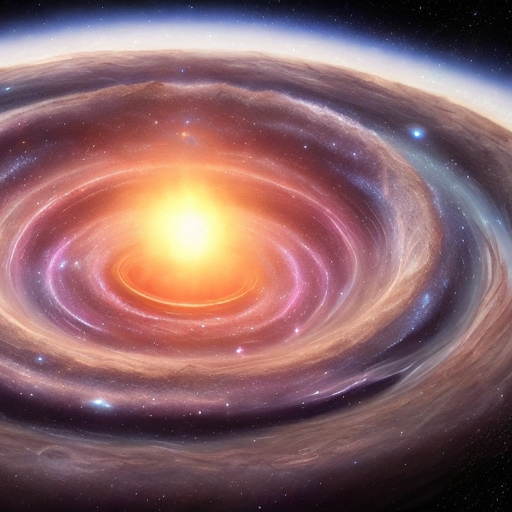
Wormholes are hypothetical features of the spacetime fabric, dubbed as ‘cosmic shortcuts’. Theoretically, they connect two distant regions of the universe — propelling one through immense spans of space or even time in mere moments. Physicists visualise these as tunnels with two ends, each at separate points in the space-time continuum.
Albert Einstein and Nathan Rosen’s pioneering work in 1935 laid the groundwork for the concept of wormholes. They introduced a theory called the ‘Einstein-Rosen Bridge’, a solution to the equations of General Relativity. It described these bridges as hidden within the mysterious black holes, providing an entry and exit, or essentially a tunnel.
One could imagine dropping a piece of paper and piercing both ends with a pencil. Here, the pencil represents the wormhole, an interconnecting path between the two points, whilst simultaneously bypassing the space in between.
Wormholes and Time Travel
The connection between wormholes and time travel comes from the implications of Albert Einstein’s theory of General Relativity, which states that the involvement of enormous masses or energy can curve and distort spacetime.
Now, theoretically, if one end of a wormhole remains fixed while the other end moves at high speed or is within a strong gravitational field, this induces a phenomenon called ‘time dilation’. Here, time flows differently at both ends, enabling what could practically be an act of time travel.
The idea is unquestionably mesmerising, with science fiction frequently exploiting it to spin tales of characters navigating through time.
Challenges to Practical Application
Unfortunately, the reality of time travel via wormholes is not quite as simple as it first appears. The act relies upon principles of theoretical physics that, while internally consistent, lack empirical evidence. Therefore, accepting their existence is a leap of faith in our understanding of the cosmos.
Secondly, wormholes, as predicted by Einstein and Rosen, are predicted to be unstable, collapsing instantly. For a wormhole to exist long enough for anything to travel through, some form of ‘exotic’ matter with unusual properties — such as negative energy density — would be needed to keep the ‘tunnel’ open. However, such matter is purely speculative and yet to be substantiated.
Furthermore, even if we could stabilise a wormhole, navigating it would be another hurdle. The immense gravitational forces, likely associated with wormholes, could spaghettify anything that tries to pass through.
Future Discoveries
Despite the challenges, the notion of wormholes and their potential usage for time travel should not be discarded as mere fantasy. It serves as an intellectual exercise to push the boundaries of human understanding, a breadcrumb trail through the labyrinth of intricate cosmic laws.
The idea signals the depth of imagination we can apply to decipher the universe’s mysteries, using established scientific theories as a foundation. Perhaps, with advancements in quantum physics and a more profound understanding of the universe, we may discover characteristics of the cosmos that make wormhole-induced time travel plausible.
As long as our search for a deeper understanding of the cosmos continues, science will persist with examining seemingly outlandish concepts like wormholes. The progress could be slow and riddled with uncertainties and redefinitions; however, at the heart of these explorations is the indomitable human spirit of discovery, making the impossible seem possible.
In Conclusion
While the theory of using wormholes for time travel is based on consistent physical principles, it remains fraught with questions and challenges. Yet, it continues to captivate scientists and curiosity-driven individuals alike. With an ever-evolving understanding of the universe, while wormholes and time travel may currently sing a melody of science fiction, the future may hold astounding revelations that could transform this fiction into reality.
In the interim, wormholes offer us an intriguing framework, a thought-provoking metaphor, to underscore the limitless potential of the human mind in gauging the seemingly incomprehensible mysteries of the cosmos.
 The Secret Paranormal Investigator